
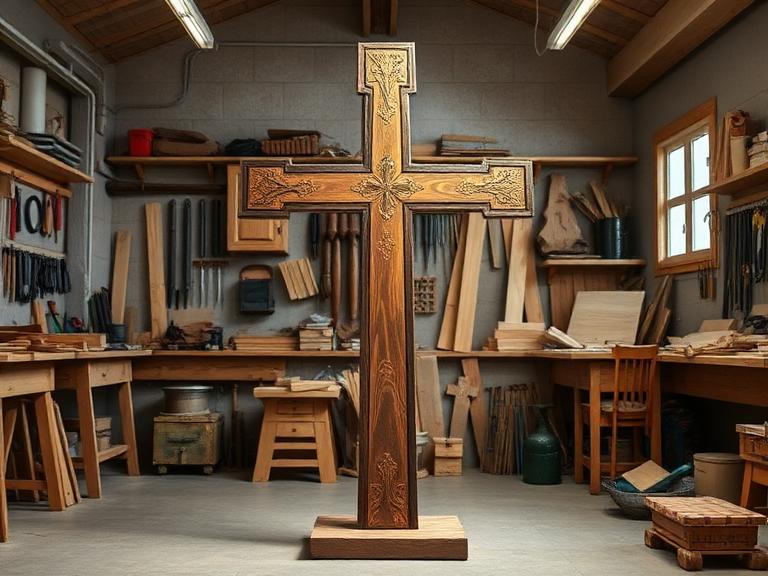
The Latin Cross, or Standard Western Cross, is one of the most recognizable symbols of Christianity. Its history is deeply rooted in biblical tradition, early Christian worship, and symbolic theology. Here’s how its meaning unfolds – historically, theologically, and in its significance for believers today – while incorporating biblical depth with contemporary relevance, written in a vibrant and reflective style.
Table of Contents
The Origin and Early History of the Latin Cross
1. Roots in the Early Christian Era
Before the Latin Cross became the central symbol of Christianity, early Christians used simpler symbols like the Ichthus (fish), the chi-rho (☧), or the anchor to identify themselves in secret (the “Catacombs” of Rome often display these). But when Christianity emerged as a recognized religion (after Emperor Constantine’s “Vision of the Cross” in the 4th century), the Latin Cross evolved into its iconic form. Constantine’s conversion after seeing the cross with the words “In Hoc Signo Vinces” (Latin for “In this sign, you will conquer”) on the battlefield symbolized the cross’s power as a divine shield.
Yet before Constantine, the cross had symbolic roots in Jewish and Greek traditions – representing victory over death (as in Exodus 15:2-3), redemption (Hebrews 2:14-15), and divine authority. But in Christian theology, the cross became the ultimate display of God’s love in action (John 3:16, Galatians 6:14).
2. Evolution of the Cross Shape
The Latin Cross resembles a “T” when viewed from the front but leans on a vertical beam with a smaller horizontal one intersecting it. This design traces back to:
- Roman crucifixion practices – victims were nailed to wooden crossbeams.
- Eastern and Western divergence – The “plus sign” shape (tau in Greek) wasn’t initially the focal point; early Christians saw the horizontal bar as the burden of human sin and the vertical line as the divine connection between heaven and earth (John 14:3-6).
By the 4th century, Christians began erecting monumental crosses (cruxes immoles) to mark churches (like St. Peter’s Basilica). By the Middle Ages, the cross took on more elaborate designs, including Christ’s figure embedded in it (the “crucifix”), reinforcing the belief that the cross was not just a symbol of sacrifice but of resurrection.
Symbolic Theology of the Latin Cross
The Latin Cross is a theological triad – it embodies three intertwined truths:
1. The Vertical Beam: Divine Love and Sacrifice
“The Father loved the Son, and gave Him up for us all” (Romans 8:32, NRSV).
The long vertical line symbolizes God’s vertical nature—our connection to the Infinite (Gen. 1:26-27, Col. 1:15). When Jesus’ body hung on it, He bore the sin of the world (1 John 2:2)—sin, the horizontal separation between humanity and God, was bridged by His death.
2. The Horizontal Beam: Human Brokenness and Redemption
“For God was in Christ, reconciling the world to Himself” (2 Corinthians 5:19, NRSV).
The horizontal bar represents the weight of sin – the gap between God and humanity caused by rebellion (Romans 5:8). It was Jesus’ choice to stretch Himself across that divide, making a way back to God. Paul’s words in Galatians 6:14 encapsulate this: “But far be it from me to boast, except in the cross of our Lord Jesus Christ, by which the world has been crucified to me, and I to the world.”
3. The Convergence: The Resurrection
The single point of intersection is where divine and human meet. This is where Jesus’ last words, “It is finished” (John 19:30, NRSV), echoed – not just as a cry of surrender but as a proclamation of victory. Death could not contain Him; three days later, the cross itself became the symbol of new life.
“Since, therefore, we have now been justified by His blood, how much more shall we be saved from God’s wrath through Him?” (Romans 5:9, NRSV).
Contemporary Significance: Why the Cross Matters Today
The Latin Cross isn’t just a historical artifact – it’s a living symbol of transformation. Here’s how it resonates in modern faith:
1. A Reminder of Grace Overworks
In a culture that celebrates self-sufficiency (“I did it myself!”), the cross declares: “You couldn’t.” Human efforts – good deeds, moralism, or even “church attendance” – can’t bridge the chasm sin creates (Titus 3:5). The cross humbles us before a God who willingly chose to pay our debt (Isaiah 53:5-6).
Example: Picture a person drowning in guilt after a moral failure. The cross stands as an anchor, not because they “fixed” themselves but because Christ’s arms were outstretched to pull them from the depths.
2. A Call to Countercultural Living
“Do not conform to the pattern of this world, but be transformed by the renewing of your mind” (Romans 12:2, NRSV).
The cross isn’t just about what God did – it’s a lens through which we see the world differently:
- Power vs. Sacrifice: The world says, “Seize control.” The cross says, “Be servant to all” (Mark 10:45).
- Pleasure vs. Purposelessness: The world whispers, “Do what feels good.” The cross whispers, “Find joy in bearing the cross” (Matthew 16:24-25).
- Justice vs. Judgment: The world often seeks retribution; the cross shows love that judges (1 John 4:8).
Modern Application: A follower of Christ who refuses to bear “the cross” today—whether through persecution, loneliness, or persecution—is one who walks in the footsteps of Jesus.
3. A Memorial of Hope Beyond Death
In a world obsessed with fleeting trends, the cross is eternal. It declares:
- Every ending has a new beginning (Revelation 21:3-4).
- Even in suffering, Christ’s resurrection is our “yes” to tomorrow.
Example: A grieving widow looks at a cross. It’s not just a reminder of loss – it’s a promise that “death has lost its sting” (1 Corinthians 15:54-55). The cross, then, becomes a lighthouse for those walking in darkness.
4. A Call to Share the “Good News”
The cross isn’t just a decoration; it’s a gospel in wood:
- It’s a question: “Who am I without Christ?”
- It’s an invitation: “What’s stopping you from receiving His forgiveness?” (John 5:42-45).
Today, the cross challenges believers to speak boldly – not as condemners, but as witnesses to a redeeming love (Matthew 28:19-20).
Addressing Doubt and Doubting Hearts
For those who wrestle with why an all-powerful God would subject Himself to a humiliating death, the cross becomes a site of paradox:
- The “why” of pain: Jesus carried the cross not to explain pain but to enter into it with us (Hebrews 4:15-16).
- The “what” of hope: He didn’t just die to remove suffering – He promises that we, too, will rise (Philippians 3:10-11).
Prayer Example: “God, I can’t wrap my head around how love could look this ugly. But help me see that here, on the cross, is where Your power became tender.”
The Latin Cross in Our Daily Lives
- Apostles lived with crosses – Paul famously carried his burdens with the cross in mind (Galatians 6:17). Today, we’re called to carry “the cross” in every relationship, work, or challenge (Matthew 16:24).
- The world mocks it – But the cross says: “What the world condemns, I adopt.” (Galatians 6:14).
- It’s a badge of identity – Christians wear it as armor against despair (Isaiah 59:17) and as a nonverbal witness to those who’ve lost faith in morality without meaning.
Final Thought: Why This Still Matters
In a culture that commodifies faith – turning Christianity into a “brand” or moral checklist – the Latin Cross stands as a living rebuttal. It says:
- Salvation isn’t an app; it’s a sacrifice.
- Hope isn’t a self-help book; it’s a risen Savior.
- Justice isn’t a political slogan; it’s a cross-bearing movement.
To hold up the cross today is to reaffirm that no matter what life throws at us, we’re not defined by our mistakes – but by His mercy. The cross, then, isn’t just a historical symbol – it’s a promise that He’s still holding us up.
“And I, when I am lifted up from the earth, will draw all people to myself” (John 12:32, NRSV).
How might you see the Latin Cross differently today? Could it be a signpost leading you to a new understanding of God’s love in everyday moments?
🕯 Does this article inspire you?
Do you like to share within the community your experiences, thoughts and questions?
So please leave us a comment below – thank you.
